Taking Down the Steam Plant Smokestacks:
The danger, the Recognized Standard, and the Safer Path
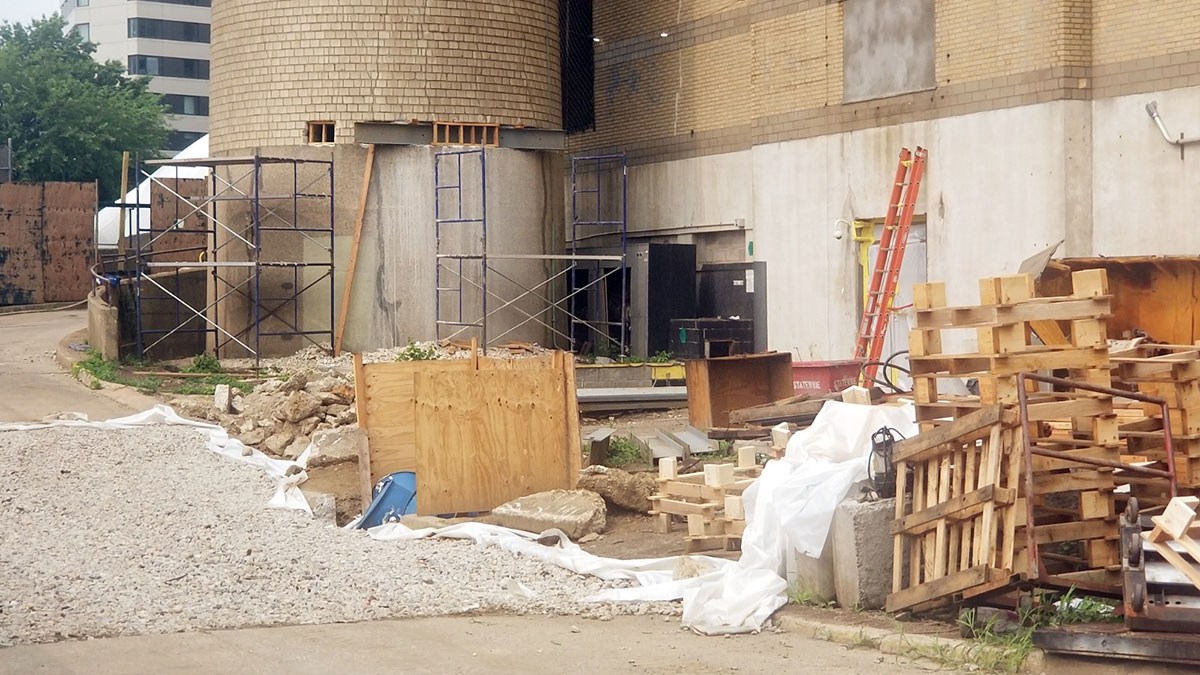
The most dangerous, most specialized part of this project — hand-demolishing two masonry smokestacks over 200 feet tall, in a dense residential and medical community — is being carried out by a contractor and engineers the city could not confirm have any chimney-demolition specialization. And by the city’s own admission, none of it is an emergency.
THE STANDARD VS. WHAT’S ON THIS JOB
THE RECOGNIZED ORDER OF OPERATIONS
- Inspect first – a full hands-on structural inspection by a qualified person, before the stack is touched; opening a stack of unverified condition risks uncontrolled collapse. (OSHA 1926.850(a) requires a competent person’s engineering survey before any demolition.)
- Repair if needed – the stack may have to be stabilized first, so it is sound enough to come down without collapsing during the work.
- Characterize the contaminants – test the residue in the brick, mortar, and lining first; it governs both the demolition method and how debris is safely disposed of.
- Specialist plan – a chimnev-and-demolition engineer sets the means and methods, controls the debris, and protects air, soil, and community.
WHAT THE COMMUNITY HEARD ON THE RECORD
- Buildings Dept: there is no requirement for the contractor or engineer to specialize in chimneys; chimney specialization “isn’t a thing that we focus on” — “I don’t think that exists.”
- HPD: this is the agency’s first chimney-stack demolition – it “hasn’t demolished a chimney stack.”
- Asked twice whether any engineer on the job is a chimney expert, HPD’s demolition director said he’d “have to get back to you” — and did not answer.
- A resident asked for a chimney-demolition specialist to explain how the method is safe. The question went unanswered.
The problem is not the method itself – top-down hand demolition is a recognized specialty — if done properly. It is the order: the base of one stack was opened before the community has any confirmation that a full structural assessment was done — and the city’s own Department of Buildings issued a stop-work order on that chimney work, still in effect. The agencies could not confirm chimney demolition expertise on the job. We have asked them to confirm both. This is not a project to “learn on the job.”
And an even more important question: are there safer, better alternatives?
THIS IS NOT AN EMERGENCY — SO THERE IS TIME TO DO IT RIGHT
The city’s own First Deputy Commissioner of Buildings said on the public record: “I did not say emergency.” The demolition
order is a maintenance order, separate from the completed emergency order to seal the building. When demolition is a policy
choice, not an emergency, the city has the time – and the obligation – to choose the course that protects the community.
THE SAFER PATH COSTS THE SAME – AND CREATES AN ASSET
- An independent chimney specialist inspected both stacks and found them in “very repairable condition,” about $700,000 – essentially equal to the city’s roughly $750,000 demolition permit.
- A chimney specialist already repaired one of these stacks in 2023 (Gibraltar Chimney International, ~$80,594, with a Buildings Dept. Letter of Completion) — a specialist was used on this very structure before.
- Repair keeps 75 years of combustion residue in place and drops nothing on the tram, the bridge bike lane, Main Street, or the racquet club 8 ft away.
- And repair turns a liability into a revenue-generating asset — a chimney observation experience on the model of London’s Lift 109, and even a bridge-to-island bike connection. Demolition produces rubble and forecloses all of it, permanently.
WHAT HAPPENED THE LAST TIME A CITY SKIPPED THIS
In 2020, Chicago let a developer bring down a coal-plant smokestack without adequate specialization or oversight. The dust
cloud coated a neighborhood for blocks; the Inspector General found “negligence and incompetence”; the public cost topped
$12.6 million. Roosevelt Island is worse on nearly every measure — a more toxic fuel, occupied structures feet away, a
hospital, kindergartens and schools, an open petroleum spill on site, an asbestos-removal violation and stop-work order.
WHAT WE ARE ASKING
- Stop the smokestack demolition.
- Bring in an independent engineer and contractor who specialize in tall-chimney work to review the method and the repair alternative before any further stack work. Share the full results and the means and methods with the community.
- Commission a feasibility study for repair and adaptive reuse — with active Roosevelt Island community participation.
The agencies admit there is no emergency — so there is time.
Sources: OSHA 29 CFR 1926.850(a) & 1926.32(f); NDA Demolition Safety Manual; independent chimney inspection (Industrial Chimney & Smokestack LLC, Mar. 6, 2026); 2023 repair (Gibraltar Chimney International, DOB Letter of Completion); statements at the July 15, 2026 public community meeting and the April 15, 2026 public town hall; City of Chicago Inspector General report on the Crawford smokestack (2023).
Prepared by ArchRica for public discussion – not professional environmental, engineering, health, or legal advice. Compiled from public records, agency statements, and published standards; an exercise of the First Amendment right to petition the government.